Coriander can provoke such strong reactions. You either love it with your whole chest, or you’re the person at the table quietly pushing it to the side and hoping nobody notices.
There is no in-between. And yet, for all its divisiveness, coriander is one of the most widely used herbs on the planet. It’s been woven into the food cultures of dozens of countries and is absolutely central to some of the most beloved dishes in Asian cooking.
So, What Exactly Is Coriander?
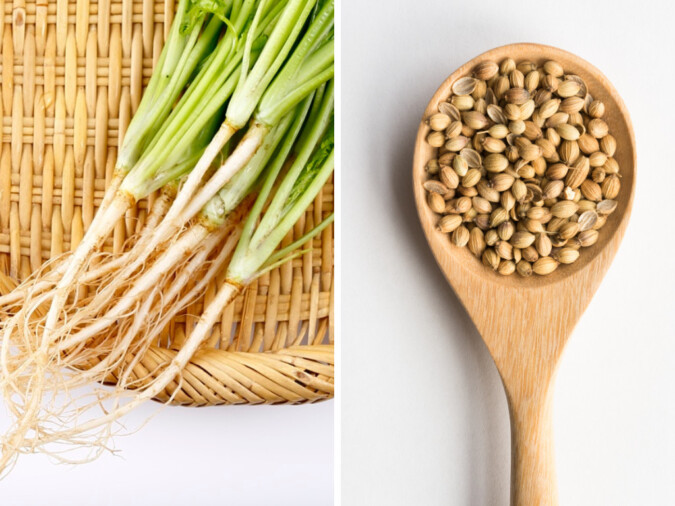
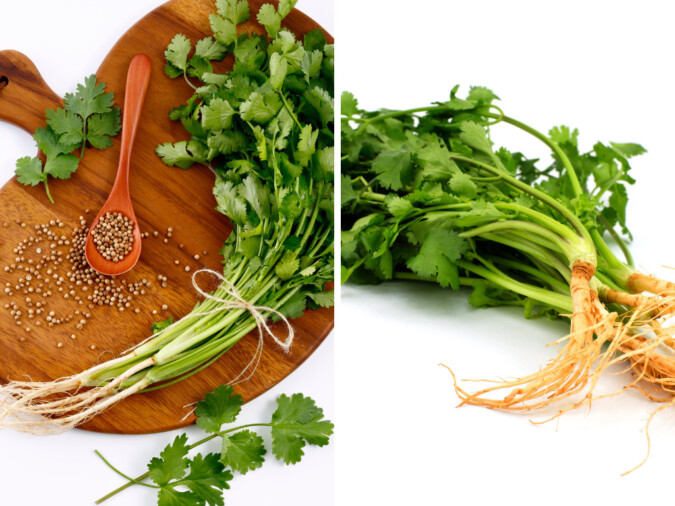
Coriander (Coriandrum sativum for my fellow nerd cooks) is an annual herb from the Apiaceae family. This includes parsley, celery, and carrots. The whole plant is edible, including the leaves, stems, seeds, and roots. Different parts of coriander are used in different ways depending on where in the world you are.
It’s believed to have originated in regions spanning Southern Europe, Northern Africa, and Western Asia, with records of its use dating back thousands of years.
Coriander seeds have been found in ancient Egyptian tombs.
It’s mentioned in Sanskrit texts. This is not a new herb. Coriander has been feeding and flavouring human meals for a very, very long time.
In the West, coriander tends to refer to the seeds, while the leaves are called cilantro (particularly in North America). In most of Asia and the UK, the whole plant is simply called coriander.
Whichever name you use, we’re talking about the same thing.
Coriander in Thai Cooking
If you’ve ever made a Thai curry paste from scratch, you’ll know that coriander root appears in the ingredient list almost without exception. In Thai cooking, the root is arguably the most important part of the plant, and it’s used in ways that most non-Thai cooks have never even considered.
Why the roots?
The root has a much more intense, earthier flavour than the leaves.
Where the leaves are bright and citrusy, the root is deeper, more complex, and holds up beautifully to heat and long cooking times. This makes it perfect for pastes and slow-cooked dishes. This is where you need that flavour to last through the whole cooking process, not evaporate the moment it hits a hot pan.
Interestingly, Thai supermarkets often sell coriander roots on their own, separate from the rest of the plant.
If you’ve wandered through a fresh market in Bangkok or Chiang Mai, you’ve probably seen small bundles of just the roots sitting alongside the galangal and lemongrass.
Saam Kluer: The Holy Trinity of Thai Cooking
Here’s something worth knowing if you’re getting serious about Thai food.
Saam kluer (สามเกลอ), which translates loosely as “the three companions,” is a foundational flavour base used across Thai cooking.
It consists of coriander root, garlic, and white pepper, and it is the starting point for an enormous number of Thai dishes, including marinades, soups, stir-fries, and of course, curry pastes.
Think of it like the Thai equivalent of a French mirepoix or an Italian soffritto. It’s the foundation everything else is built on. When you pound these three ingredients together in a mortar and pestle, the flavours meld into something greater than the sum of their parts. That base aroma becomes the backbone of the dish.
Coriander Across Asia
Thai cooking doesn’t have a monopoly on coriander. This herb has made itself at home across the entire continent, and each cuisine uses it a little differently.
In Chinese Cooking
Coriander leaves (often called Chinese parsley in older cookbooks) are used as a finishing herb. They are scattered over soups, dumplings, and braised dishes right before serving. It’s not usually cooked into the dish so much as placed on top, adding freshness and fragrance.
In Indian cooking, coriander shows up in almost every form.
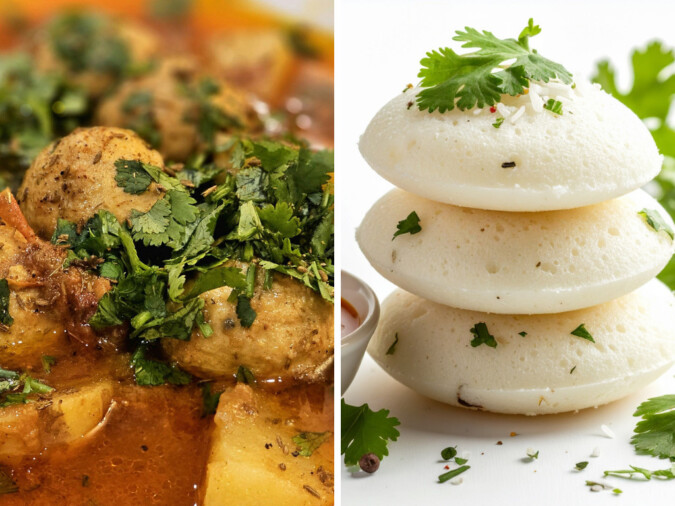
The dried seeds are ground into one of the most widely used spices in the subcontinent, forming the backbone of countless spice blends and curry powders.
Fresh leaves are blended into chutneys, stirred into dals, and used as a garnish over everything from biryani to street snacks. If Indian cooking had a signature herb, this would be it.
In Vietnamese cooking…
Fresh coriander leaves appear alongside a whole family of other fresh herbs served at the table.
A bowl of pho arrives with a plate of herbs on the side, and coriander is almost always part of that spread. Vietnamese cooks also use a related plant called Vietnamese coriander (rau ram), which has a similar but sharper, more peppery flavour.
Different plant, same aromatic spirit.
In Cambodian cooking…
Coriander plays a role in kroeung, the fragrant paste that forms the base of many Khmer dishes.
Much like Thai cooking, it’s the root and lower stem that are prized here, pounded into a paste alongside lemongrass, galangal, and turmeric.
The influence of Cambodian and Thai culinary traditions on each other is clearly visible in how both reach for the same foundational ingredients.
Why Some People Think Coriander Tastes Like Soap
Right, let’s address the elephant in the room. Or rather, the herb on the plate that a surprisingly large number of people genuinely cannot stand.
If you’ve ever heard someone say coriander tastes like soap or even like bugs, they’re not being dramatic. There is a genuine scientific explanation for this, and it comes down to genetics.
It’s all in the chemistry
Coriander contains a group of chemical compounds called aldehydes. Specifically, certain unsaturated aldehydes that are very similar to the compounds found in soap and some insects.
For most people, the brain processes these aldehydes alongside all the other aromatic compounds in the herb and registers the overall result as “fresh, citrusy, herby.”
But for a subset of the population (studies suggest somewhere between 4% and 14%, though it varies significantly by ethnicity), a particular variation in the OR6A2 gene causes the brain to latch onto those soapy aldehyde compounds and amplify them, drowning out everything else.
The result is that these people taste something different to everyone else. The herb that smells floral and bright to one person genuinely smells and tastes of dish soap to another. Their olfactory receptors are wired to process it that way.
East Asian populations tend to report this aversion more frequently than South Asian or Middle Eastern populations, which is fascinating given how central coriander is to the food cultures of so many Asian countries.
It also explains why the “coriander tastes like soap” complaint tends to come up more in some dining circles than others.
If you’re in the soap camp, this is not a character flaw. It’s genetics. You are simply built differently.
So, Should You Be Using More of It?
Cooking Thai food seriously at home, or really any Southeast or South Asian cuisine? Then yes, getting comfortable with coriander in all its forms is worth the effort.
The leaves are the easy bit; most people are already using those. But the roots are where the real depth lives. If you’re not already seeking them out, you’re leaving flavour on the table.
Next time you’re at an Asian grocery store, look out for coriander roots sold separately. If you’re buying a bunch of coriander with the roots still attached, don’t throw them away. Wash them well, freeze what you don’t use immediately, and keep them on hand for your next curry paste or marinade. They freeze beautifully and are ready to use straight from frozen.
Coriander is one of those ingredients that rewards curiosity. The more you explore it across different cuisines, different parts of the plant, and different applications, the more you realise just how much it’s been quietly doing the heavy lifting in some of the world’s most beloved dishes all along.